Pages

Monday, 25 May 2020

Dominic Cummings is an Asshole, Don’t Be an Asshole Like Dominic Cummings: A Philosophical Essay

It has long been my contention that the United Kingdom of Great Britain and Northern Ireland is a nation possessed of a significant number of little Hitlers for whom the only thing they love more than imposing rules on people is breaking rules they think shouldn’t apply to them.  Now this may seem axiomatic to a lot of you, but it’s something I’ve been thinking about increasingly frequently since the 2019 general election, and the current COVID-19 crisis has only exacerbated this feeling.  While most people have obeyed lockdown rules for the greater good of public health, others have, to be blunt, taken the piss (with the Conservative government’s vague and ever-shifting advice providing a handy veil of plausible deniability in the case of my compatriots who seem to believe that possibly transmitting the virus to other human beings and killing them is an acceptable risk to take in the name of enjoying a day out at the beach).  And of those who have accepted the reality and necessity of being locked down, there would seem to be a direct correlation between their levels of resentment and time spent grassing their neighbours up on social media for daring to be outside, with no thought given to whether they might simply be taking their legally-mandated daily walk around the block, rather than being on their way to stand outside a garden centre coughing on the customers.  As an asthmatic with an immunosuppressed partner, I realise the importance of enforcing social distancing to stop the spread of COVID-19 more than most, but there are clearly a number of Brits out there who are clearly relishing the chance to act as self-appointed lockdown police.  Not for nothing did the comedian Stewart Lee describe Twitter as “a state surveillance agency run by gullible volunteers”.

It’s this resentment that I want to talk about in light of recent revelations concerning Dominic Cummings (special advisor to Prime Minister and thinking person’s moron Boris Johnson), his apparent two trips up to County Durham last month in clear violation of lockdown laws, and the extent to which this makes him an asshole.  Now, to be clear, I’m not using the word “asshole” as a subjective pejorative term based on the man’s hard-right politics.  Sure, he ran an abusive anonymous Twitter account with the aim of venomously smearing opponents of then-Education Secretary Michael “Tesco Value Slappy the Dummy” Gove, he helmed a Vote Leave campaign which weaponised and exacerbated rank xenophobia, and he seems to have a worrying interest in eugenics, but while I might (and do) call him an asshole for this, if you were a committed Tory you might say that these were not the actions of an asshole but of a patriot who uses robust methods to gain desirous outcomes for his country.  (You’d also be cordially invited to fuck off and stop reading this blog forever, but that’s beside the point.)  Rather, when I call Dominic Cummings an asshole I am doing so specifically in relation to his breaking lockdown, using the word as the moral philosopher Aaron James does in his brief, amusing 2012 treatise Assholes: A Theory.

The bulk of James’ book is concerned with attempting to construct a working definition of the asshole qua asshole.  This does not encompass genocidal monsters; as James explains, “There are not enough harsh names for these figures, and it is fine to add ‘asshole’ to the list.  But it would be deeply offensive to only call Hitler or Stalin an asshole; there are much more important ways to describe them morally.”  Rather, James concerns himself with “the mere asshole”, the kind of low-level irritant, jerk or boor you come across every day (at least when you’re not staying home to protect frontline health services).  He defines this kind of person as one who:

1) “allows himself to enjoy special advantages and does so systematically”;
2) “does this out of an entrenched sense of entitlement” and
3) “is immunised by his sense of entitlement against the complains of other people”.

They are the driver who cuts you off on the motorway, or the shopper who doesn’t put the trolley back where they found it when leaving the supermarket.  In short, they believe themselves exempt from the rules that others are compelled to abide by; not just in terms of obeying the law, but fulfilling unwritten moral contracts governed by innate or socially constructed sense of “the right thing to do”.

It goes without saying that the asshole, as James has it, would not believe that it behoves them to observe lockdown regulations, and would be far too selfish to recognise as legitimate the argument that they should limit their own activities to protect others.  By this definition, Dominic Cummings, despite his argument that he drove 260 miles from London to County Durham to arrange childcare for his four-year-old son when he and his wife came down with COVID-19 symptoms, can be termed an asshole, because he put others at risk of infection.  He did so not only by almost certainly coming into contact with non-COVID-positive human beings in the course of his two journeys north, but by markedly undermining public confidence in the lockdown.  This undermining is especially risky for public health because of the presence in British society of a type of asshole that James’ book doesn’t cover: the person - usually white, middle-class and comfortably off - who believes they have a right to bend or break the rules not simply because they innately believe themselves entitled to “special advantages”, but because they feel, paradoxically, that they have earned this right because they are the sort of person who always follows the rules.

To elaborate on how people come to believe this, another philosophical detour seems in order, one that seems especially relevant considering we’re discussing a matter of state intervention in public health.  The philosopher Michel Foucault conceived “biopolitics” as the set of technologies - including statistical analysis, public health and education - by which governments seek to create a well-behaved and pliant population (which Foucault called a “superrace”) in order to engender efficient economic production and the orderly running of society.  Those who are perceived to resist this ordering, on account of actions, cultures and even genes which are deemed deviant, are considered a “subrace” from which governments determine the superrace needs to be protected.  For Foucault, race and racialisation are less about skin colour than a constantly shifting conjunction of infinitely variable biological and behavioural signifiers.

Other thinkers have sought to complicate Foucault’s distinction between superrace and subrace.  Taking a term from Roman law, Giorgio Agamben defines those who resist biopower’s ordering of the community as homo sacer (meaning “bare life”), suspended between bios and zoē: between superrace and subrace.  For Agamben, under regimes of biopower “the realm of bare life - which is originally situated at the margins of the political order - gradually begins to coincide with the political realm, and exclusion and inclusion, outside and inside, bios and zoē, right and fact, enter into a zone of irreducible indistinction”.  In short, they produce “a legally unnameable and unclassifiable being” that is placed into what Agamben calls a “state of exception [which] is neither external nor internal to the juridical order" of the biopolitical state.  As it proves consequently “impossible to distinguish transgression of the law from execution of the law, such that what violates a rule and what conforms to it coincide without any remainder”, the people the state constructs as homo sacer remain at its mercy, their legally uncertain status rendering them susceptible to all kinds of abuses.

It’s not so much in vogue as a way of conceiving technologies of political oppression as it used to be, but many thinkers earlier in the 21st century found biopolitics very useful as a way of framing the categories and the logical contortions the architects of the War on Terror produced to justify its excesses (and, indeed, its very existence).  In 2002 Slavoj Žižek wrote of “the ‘unlawful combatant’, who is neither enemy soldier nor common criminal” as a form of bare life, and a year later Agamben himself noted the “immediately biopolitical significance of the state of exception as the original structure in which law encompasses living beings by means of its own suspension emerges clearly in the ‘military order’ issued by the president of the United States on November 13, 2001, which authorised the ‘indefinite detention’ and trial by ‘military commissions’ (not to be confused with the military tribunals provided for by the law of war) of noncitizens suspected of involvement in terrorist activities.”  This is not to say that states which are willing to circumscribe or mystify legal rights within carceral spaces will necessarily limit themselves to just that.  As François Debrix and Alexander Barder argue, “the virtual ‘real possibility’ of the exception (Guantanamo, Abu Ghraib) may also seek to draw our attention towards the idea of a supposedly unique, unusual, extreme, or indeed ‘exceptional’ zone as if such a site were not the norm, or as if it were not supposed to be real or actualised anywhere else”.  That is, a state which creates a state of exception somewhere can and will do so everywhere if it considers it necessary.

So what does this have to do with your middle-class curtain-twitching lockdown enforcers, you might ask?  After all, insofar as the British state apparatus constructs homo sacer from the bodies present within the borders it administers – and it definitely does – it does not do so from among the “squeezed middle” or “just about managing”, to use two equally risible phrases coined by our nation’s two main political parties to describe the lower-middle class in the 2010s.  Rather, it does so in spaces like the Yarl’s Wood detention centre, and on the streets so many have been forced to make their home in the age of austerity.  However, never let it be said that the comfortably-off white British people with whom I am concerned lack the imagination to conceive the existence of people simultaneously bound by and detached from the law; more accurately, detached because they are bound.  Only, they do not imagine a homo sacer oppressed by this legal indistinction, but one that enjoys the right to be liberated by it.  And the identity of this pseudo-bare life is themselves.

Ours is a country whose national discourse is suffused simultaneously by a deep sense of superiority and a deep persecution complex, which leads the folks mentioned above to misappraise their standing in society in three main ways.  Firstly, you have those who like to imagine themselves as some kind of oppressed minority, because the PC brigade won’t let you push dog shit through the letterbox of the Asian family down the street anymore and are gifting honest working Britons’ taxes to house definitely-not-imaginary Somali asylum seekers in palatial Kensington estates.  Then there are the “what if I went to private school but had fuck all money throughout?” crew, the people who are convinced that because their lifestyle is typical amongst their social set and because they have little money left over every month because most of their salary is tied up in Porsche car loans/multiple mortgages on their buy-to-let empire/paying for their kids’ tennis lessons in an attempt to buy forgiveness for cheating on their mother with a work colleague, they are therefore nothing more or less than Average Joes.  By way of example, witness this frothing gammon steak confront my local MP on Question Time to declare that he, a man earning more than £80,000 per annum, was not in the top 50% of earners in the country (the UK median salary is just over £30,000).

Then you have the third kind: the assholes.  Specifically, the assholes who believe that their shining virtue in following the rules gives them the right to flout them, and to not be punished for flouting them (and, indeed, to not be considered to have flouted them at all) by dint of their being, at their very core, “the sort of person who always follows the rules”.  Now, we already know that your freedom to disobey laws, rules and conventions is largely dependent upon your class, race, gender and political alignment.  Contrast the wall-to-wall media coverage of mostly white Brits attending “socially distanced” (but clearly not actually socially distanced to anyone with eyes) VE Day street parties with the solemn advice issued to Muslims to observe the holy day of Eid ul-Fitr within the privacy of their own home.  Or consider the recent row wherein Sarah Vine, right-wing newspaper columnist and wife of cabinet minister Michael Gove, in an apparent attempt to rub her privilege in the faces of her “trolls”, tweeted a photo of their shared bookcase which included, amongst its many delights, a discredited tome by a “race scientist” which argued that black people are inherently less intelligent than whites, and a history book by a convicted Holocaust denier.  I know that playing the “can you imagine the media reaction if Jeremy Corbyn had done this thing that a Tory did?” game is incredibly futile, especially now he’s been replaced as leader of the Labour Party by a sentient necktie with a nice line in forensics and shafting the left, but come the fuck on.  Already widely castigated as an anti-Semite by the right-wing press (and much of the liberal media at that), he’d have been raked over the coals.  With regard to Dominic Cummings, the risible clown college known as the Daily Telegraph ran a piece yesterday by anti-immigration flange David Goodhart which argued that “There is a kind of hyper-democratic rancour abroad that refuses to contemplate that our rulers, at least while they are ruling, deserve some special treatment”, which I at least appreciate for saying the quiet part loud.  I could go on.

However, we’re specifically talking about the people who claim the right to defy rules not by dint of race, class, gender or political bent, but by their own lawfulness.  The British like to imagine themselves as people who go about their lives guided not only by the rule of law but by manners that are not codified in any statute but are followed because they are moral goods in and of themselves.  It’s how we get this fetishisation of good-natured queueing as an especially British trait, despite the fact that 1) foreigners seem perfectly able to do this as well even if they’ve never been to Hemel Hempstead, and 2) people in the UK have a capacity to become extraordinarily rude and irritable if the amount of time spent queueing is, say, 10% more than what was expected.  As such, many - especially those comfortably-off middle-class whites unused to being told “no” - feel entitled to a reward for doing things “the right way”.  You see it in the deployment of the phrase “otherwise law-abiding motorists”; as the argument goes, I pay my taxes on time, I’ve never stolen or committed assault, so why shouldn’t I be able to break the speed limit if I want to?  After all, I’m a model citizen, and I always obey the law.

It’s this dynamic which explains the ferocity of the reaction to Dominic Cummings’ breaking of lockdown by newspapers and commentators usually so slavish in their support of the Conservative Party (when the Spectator is calling for you to go, you done fucked up); newspapers and commentators enjoyed by vast swathes of the social group described above.  People who shrugged away or even celebrated existing double standards regarding rule-obeying and rule-breaking are up in arms because the expectation of reward inherent in the construction of the “otherwise law-abiding” pseudo-homo sacer has been violated.  Free speech absolutists in the Tory press who defended Sarah Vine’s right to own books by a Holocaust denier, knowing full well that the same freedom to own whatever books one desires is not necessarily possessed by others without the privilege of being employed by said Tory press - we might call these people “asshole enablers” - have suddenly discovered that “special advantages” are not acceptable when someone in power has wielded a perceived right (the right to defy lockdown for the sake of one’s family) that these enablers believed themselves unable to enjoy.  What an asshole, they think.  Was being an asshole an option all along for me as well?

Let me be clear what I am not arguing.  I am not calling ordinary people assholes for quite rightly wondering why Dominic Cummings is able to drive to County Durham with COVID-19 symptoms while they were forced to watch relatives’ funerals via Zoom.  Rather, it is precisely because they felt the pain of loss and of the unfairness of not being able to be there to hold their loved one’s hand as they slipped away, and then stayed home anyway, that they are not assholes.  There is nothing wrong with being angry that the platitudes of “we’re all in it together” issued by the Conservative Party were not true after all (as indeed, they were not true when David Cameron’s government was slashing public services to the bone in the name of “balancing the books”).  However, it is important that we do not react to the asshole behaviour of Dominic Cummings by becoming assholes ourselves.  “I guess I’ll just do whatever I want if this guy can” is not a helpful response to this outrageous behaviour, nor is it going to help us save lives.  There’s already enough people out there potentially spreading disease by refusing to socially distance, sometimes while complaining about people refusing to socially distance (“otherwise law-abiding plaguespreaders”).  And under our constantly changing “new normal” there’s already enough leeway for people to place themselves into a zone of “legal indistinction” (as Agamben might have it) in the name of their own freedom or convenience if they so desire.  Be “the sort of person who follows the rules” not because you expect it to earn you the right to disregard them when you so desire, or even because you wish yourself to be imbued with some nebulous moral virtue, but for the simple reward of saving another human being’s life.

Essentially, what I’m saying is that we need to be better than Dominic Cummings.  Based on his actions over the last few days, and the last few years, it isn’t hard.


Wednesday, 16 January 2019

Vinoo Mankad Was Right


In his book Playing Hardball, the former Test cricketer turned sportswriter (and baseball aficionado) Ed Smith writes: “Cricket is notoriously difficult to explain [to Americans], and I am only marginally more confident about clarifying the rules of baseball to the Brits.”  In my experience, the latter isn’t hugely difficult to achieve.  My parents might not have been able to tell a screwball from a sacrifice fly when we walked through the doors of the Citi Field stadium back in 2011 to see the New York Mets take on the San Diego Padres, but my mother was the first one on her feet when the Mets smacked the winning run at the bottom of the ninth, so she clearly had a good idea of what was going on.  I’ve not yet had an opportunity to give one of my friends from across the pond a crash course in cricket, but I don’t foresee any major issues.  How the sport works really isn’t hard to grasp when you get down to it.  Yes, there are dozens of fielding positions rather than the nine of baseball, but you don’t need to know all of their (mostly very stupid) names to identify when the captain has set an attacking field and when they are playing safety first.  Yes, there are ten ways to get out (it used to be eleven), but in practice only about half of them actually happen in games.  What’s much more difficult for non-fans to comprehend is the wider culture surrounding the sport, particularly how it relates to received notions of “fair play”.

The example I always use to illustrate this is Mankading, a technique named after the former Indian international Mulvantrai Himmatlal “Vinoo” Mankad.  Put simply, here’s what it entails.  As the bowler runs in to bowl, the batsman at the non-striker’s end almost always takes a few paces out of their crease, so as to gain a slight advantage in  they are called upon to run to the other end; the reasoning is that these few paces might make the difference between making your ground and being run out.  In 1947, Mankad hit upon the idea of simply stopping his runup and running the non-striker out once they had left their crease, a plan he successfully executed in the Second Test against Australia.  The Aussie media castigated Mankad for the practice – and coined the term “Mankading” in the process – but the Indian had his defenders, most notably the legendary batsman and then Australian captain, Don Bradman, who remarked in his autobiography:

“For the life of me, I can’t understand why [the press] questioned his sportsmanship.  The laws of cricket make it quite clear that the non-striker must keep within his ground until the ball has been delivered.  If not, why is the provision there which enables the bowler to run him out?  By backing up too far or too early, the non-striker is very obviously gaining an unfair advantage.”

Bradman is correct; Mankading is completely legal within the laws of the game.  Yet, because it is widely considered to be an unsportsmanlike act, you very, very rarely see it performed, and when you do it is invariably accompanied by an almighty media storm.  In the 2016 Under-19 World Cup, the West Indian team was labelled “absolutely disgraceful” by former New Zealand skipper Stephen Fleming after bowler Keemo Paul Mankaded the last batsman in a tightly-fought match against Zimbabwe, an action that sealed his team’s place in the quarter-finals.  On the other side of the coin, in 2003 Bangladesh passed up a clear opportunity to Mankad the star Pakistani player Inzamam ul-Haq, but declined.  Inzamam went on to make 138 not out, and Pakistan prevailed by one wicket.  Bangladesh, who at that point had never won a Test match, would have to wait another six years for their inaugural win.

Now, while I’ve never tried to teach the laws of cricket to an American, I have attempted to explain Mankading.  Without exception, my US friends have reacted with utter disbelief to the whole discourse.  The sport of bat and ball they are used to is baseball, which contains among its many intricacies a version of Mankading.  The pitcher, if they sense that the player on first base is attempting to steal a yard, is perfectly entitled, instead of trying to strike out the batter, to throw the ball to first base and try to tag the runner out.  They may do this as many times as they like, and sometimes you’ll see half a dozen attempts to run out the man on base before the ball even gets within spitting distance of a bat.  Catching batters stealing is part and parcel of the game; an occurrence so frequent as to be completely unremarkable.  The idea that a sports team would be so beholden to ideals of sportsmanlike behaviour that they wouldn’t use every means at their disposal to try and win a game is something my American friends find quite baffling.


All of which brings me, in a roundabout way, to Marcelo Bielsa.  At a press conference this afternoon the Leeds United manager, facing accusations that he had sent a spy to observe rivals Derby County conduct a training sessions, confounded predictions that he would either resign or offer an apology by not only confessing that he had engaged in this espionage but that he had dispatched a member of staff to observe every team Leeds have played so far this season.  He then – as if this wasn’t earth-shattering enough – fired up a PowerPoint presentation that detailed the frankly insane amount of detail gathered by him and team in preparation for the Derby game, right down to how many combined minutes their players have played in each position, and which secret hand signals correspond to which set piece routine.  Speaking with remarkable candour, Bielsa, who stated at the outset that he was confessing everything in order to help the Football League with their investigation into his behaviour, made several compelling points in his defence.  He explained that he had gained no advantage by doing this; his scouts, he stated, didn’t tell him anything his own meticulous analysis of games hadn’t revealed, and, at any rate, information on the opposition is useless if you can’t marshal your own team to take advantage.  He recounted one game during his tenure as Athletic Bilbao boss after which Barcelona manager Pep Guardiola had complimented him on how diligently he had prepared.  But for Bielsa “it was useless information because they scored three goals”.

He also hinted that he is not the only manager who engages in the practice, which I found incredibly gratifying, because the tenor of much of the criticism levelled at the manager after the initial allegations struck me as patronising and with a tangible xenophobic undercurrent.  A Match of the Day interviewer asked if he now understood that spying on other teams is not acceptable in this country, and more than one prominent pundit suggested that Bielsa would have to learn “how things are done” in the English Football League.  Even the manager’s own board threw him under the bus somewhat with a public statement asserting that Leeds United would “look to work with our head coach and his staff to remind them of the integrity and honesty which are the foundations that Leeds United is built on” (this from the club of Billy Bremner, Norman Hunter and Lee Bowyer).  To listen to these figures, you would be forgiven for wondering if we had moved on from twenty years ago, where vices such as diving and shirt-pulling were characterised as specifically foreign diseases, and a “reducer” to the legs of newly-arrived overseas players by a Vinnie Jones or a Julian Dicks or a Neil Ruddock was considered an acceptable way of nipping this sort of thing in the bud before it started.  None of this fancy Dan stuff, you’re in Blighty now, where men are real men and real men get unbelievably irate at vegan sausage rolls and shaving company adverts.  Meanwhile, you’d have been searching a long time to find an English pundit willing to argue that Michael Owen dived to win a crucial penalty against Argentina at the 2002 World Cup.  The Ricky Tomlinson film Mike Bassett: England Manager, released the previous year, brilliantly skewered these hypocrisies with a scene in which, against a fictional Argentinian outfit, mercurial midfielder Kevin Tonkinson produces a carbon copy of Diego Maradona’s notorious “Hand of God” goal to win the game, which is hailed by the English commentator as a “fantastic header”.

To act, in the Year of Our Lord 2019, as if footballing espionage was imported by Marcelo Bielsa from Buenos Aires this summer, is ludicrous.  On the latest edition of James Richardson’s excellent Totally Football Show podcast, one contributor related the very salient fact that many managers in England have, upon seeing that their club’s training ground was offering onlookers numerous vistas of its sights, ordered the planting of trees to obscure their practice drills from view.  Perhaps all these managers were reacting to utterly groundless fears, submitting to an almost Pynchonian paranoia.  Or perhaps it is as Bielsa and others have intimated, that spying is rife in English football, and the Leeds United manager has, like the boy who points out that the Emperor has no clothes, merely named what others are too unwilling or craven to admit.

And here’s the rub.  Spying is absolutely permissible within the rules set out by the Football League.  Bielsa, though he admits that “not everything that is legal is right to do”, has broken no rules.  He has been pronounced guilty, by those who have criticised him, of a type of Mankading.  The old Victorian ideal of sport as an arena not only for athletic endeavour but the display of moral probity, to which cricket seems especially beholden, clearly still holds sway in football too, despite everything.  The foreigner, moreover, is expected to abide by moral standards that by all accounts are not widely being followed by native-born Englishmen in the industry within which he works.  And it is precisely this promulgation of the notion that ours is a people uniquely characterised by fair play, our demanding that other nations follow rules by which we ourselves are only willing to abide for show – consider our repeated demands for special treatment within the EU both during and long before the Brexit negotiations – that is a chief reason many people in foreign countries quite rightly despise the English.

Hearteningly, the vast majority of the online reaction to Bielsa’s press conference has been very supportive, and not only from Leeds fans.  These is a widespread recognition that if Bielsa is guilty of anything it is being too honest about a practice many people in English football would rather wasn’t talked about, and being too anxious to make sure he has prepared as thoroughly as possible.  I’m sure many of them wish the clubs they support were lucky enough to have such a diligent manager.  And that’s a good thing.  I’m not completely instrumentalist in my approach to sport.  I recognise that there are certain things in football which, while legal, do nothing for the sport a spectacle; for example, keeping the ball in the corner to kill time, or mouthing off at the referee.  I have no time for a win-at-all-costs mentality.  However, going the extra mile to scout opponents – for that is all Bielsa has done – harms nothing of football’s essence, just as cricket would survive unscathed if Mankading became seen as a legitimate tactic and batsmen at the non-striker’s end have to start their runs later.  If anything, it raises the bar for English managers, who all too often get jobs through the old boys’ network or because they are a known quantity.  But as for the hypocrisy and petty xenophobia of the English, I have a feeling that no matter how many dossiers you might have Marcelo Bielsa prepare on the enemy, it will prove somewhat more difficult to defeat than Derby County.


Thursday, 20 September 2018

Dictators of the Centre in Doctor Who and Persona 5


WARNING: SPOILERS AHEAD

It has become a truism that we are living in an age of political extremes.  A lot of media attention has been lavished, particularly in the de facto two-party state that is England, on the re-emergence of socialism as a political force and the decline of neoliberal managerialism on the left, as exemplified by SYRIZA’s rise to power in Greece (if not its style of government in practice) and the surprisingly strong performance of Jeremy Corbyn’s Labour Party in last year’s UK general election.  On the other side we have an increasingly prevalent nationalist, nativist and authoritarian strain within right-wing politics; see, for example, Viktor Orban’s “illiberal democracy” in Hungary, the Law and Justice party in Poland and, on the other side of the Atlantic, Donald Trump.  But there is also a third political tendency positing itself against both, and enjoying electoral success in some countries.  This “Third Way” is a “radical centrism”, but a radical centrism which, concerningly for political leftists such as myself, has shifted to the right in two notable cases wherein centrist movements were able to form national governments; Italy and France.

A political movement can be defined as centrist because its policies sit consistently in an ideological space equidistant between mainstream left- and right-wing thought, because its manifesto comprises a mixture of traditionally left- and right-wing policies, or because its platform is vague or empty enough that no judgement can be made as to its overall alignment.  The largest party in this year’s Italian general election, the Five Star Movement (M5S), founded in 2009 by comedian and blogger Beppe Grillo, is an example of the second kind.  The M5S’s electoral manifesto was the eclectic slate of promises and affirmations you would expect from a party which operates in large part on the principle of direct democracy (a form of decision-making it advocates for the nation as a whole).  Traditionally left-wing policies such as support for same-sex marriage and measures to tackle climate change sat alongside a pro-Putin foreign policy, Euroscepticism and no small amount of anti-immigration posturing.  Underpinning these policies, the M5S’s campaign was characterised by the avowed anti-corruption and anti-establishment standpoint that originally propelled it to prominence, the idea that “politics as usual” no longer works.

The momentum this generated among a disillusioned Italian public has now taken the movement into government.  However, in order to command a majority in parliament, the M5S took the decision to form a coalition with the far-right Lega party, and the early months of the administration have been characterised principally by the hardline anti-immigrant rhetoric of the Lega and its leader Matteo Salvini, with the M5S offering precious little leftist action to countermand this.

Last year’s big centrist win in European politics, meanwhile, was the election of Emmanuel Macron as president of France.  Macron, a former investment banker who served in the cabinet of the Socialist president Francois Hollande between 2012 and 2016, ran on a platform he variously described as “neither right nor left” and “both right and left”.  Macron’s agenda included socially liberal ideas (he is in favour of equal marriage), but also economically right-wing pro-business policies that pledged to lower corporation tax and “unblock France” by loosening the country’s famously tight labour laws and making it easier for companies to fire workers.  How far you deem his manifesto to be truly centrist depends on your own politics, but there is no doubt he was treated as such by both the French press – Le Figaro described him as a “radical centrist” – and French voters.  Macron drew support from moderate liberal and moderate conservative elements of the electorate, beating the candidates of the two formerly dominant centre-left and centre-right parties in the first round before comfortably seeing off the far-right leader Marine Le Pen in the run-off (though many leftists who voted for him in the second round held their noses when doing so, seeing preventing a Front National government as the most important thing, as when Jacques Chirac defeated Marine’s father Jean-Marie in 2002).

However, since taking power Macron has been criticised for a drift to the right, particularly on national security and immigration; the very issues over which the M5S seem to have ceded control to the far-right Lega in Italy’s new coalition government.  The issue, then, that leftist voters who plump for centrist candidates must face is this, as demonstrated by both examples I have covered; that there is always a risk that the governments they form will be, to adapt Macron’s phraseology, “more right than left”, whether because the rightist elements of their platform become more prominent over time, or because they must form alliances with conservatives to remain in power.  Left-leaning voters who voted Liberal Democrat in the UK in 2010, only to see them go into coalition with David Cameron’s Conservative Party and help preside over a brutal austerity regime, found this out to their cost (including myself, I am ashamed to admit).

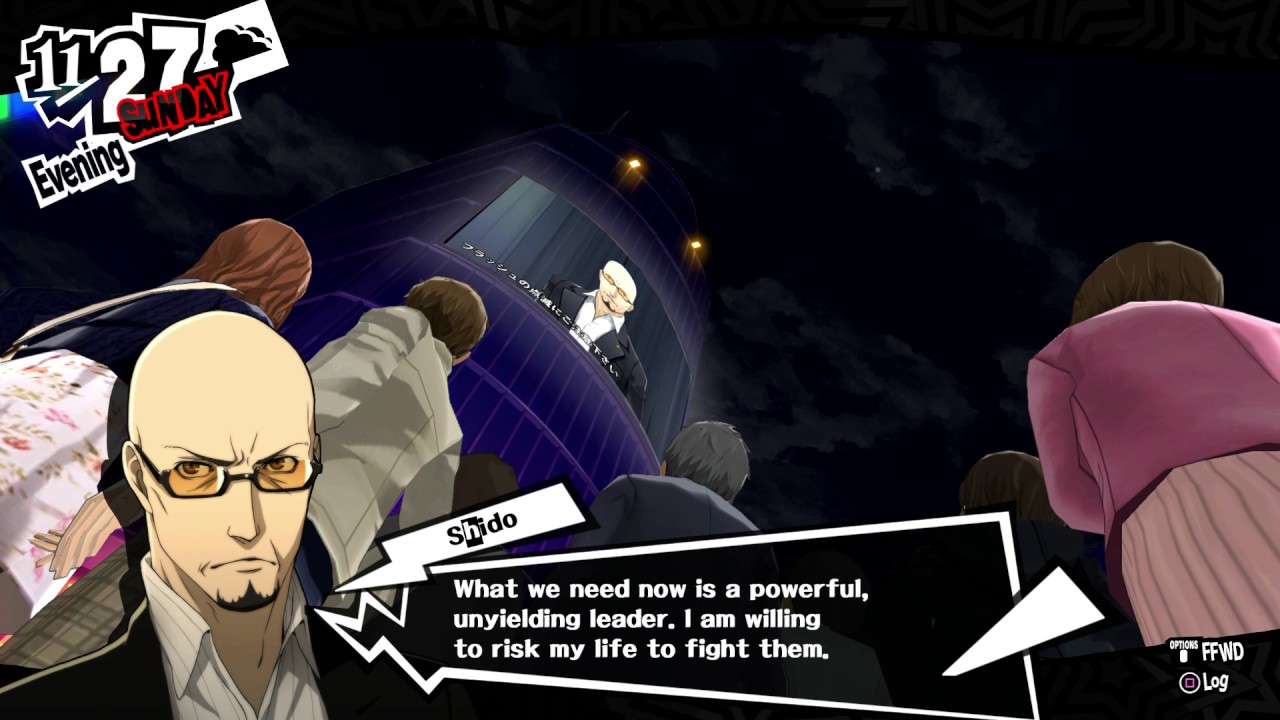
A good amount of attention has been paid by critics to works of fiction featuring totalitarian regimes of the extreme left (The Party in George Orwell’s Nineteen Eighty-Four) or the far right (the Nazi-esque Norsefire movement in Alan Moore’s V for Vendetta).  But I’d like to argue that in our present political moment, there’s interest to be had in examining a couple of fictional politicians – one dictator and one would-be dictator – each of who espouse an outwardly centrist platform.  Harry Saxon in Doctor Who and Masayoshi Shido in Persona 5 do not rise to power by promising full communism, collectivism, a patriotic war, mass deportations, brutal suppression of anti-nationalist elements, or any far-left or far-right policy.  Rather, they gain popularity through an anti-corruption, anti-establishment “big tent” approach that draws huge swathes of the public (socialist, liberal and conservative) to their side while simultaneously masking the true nature of their political project.  Both of these fictional works seem to advocate suspicion of centrist political platforms on the grounds that politicians that seek to appear as “all things to all people” may be doing so simply because it makes it easier for them to seize power through electoral success, and thus easier to execute a hidden agenda.  It is this suspicion that left-leaning voters, if they wish to guard their nations against the depredations of the political right and far right, would do well to adopt.

Image result for harry saxon

In “The Sound of Drums”, the penultimate episode of the 2007 series of Doctor Who, the Doctor (David Tennant) and his companion Martha (Freema Agyeman) discover that his nemesis, The Master (John Simm), has become Prime Minister of the United Kingdom under the alias Harry Saxon.  Saxon is depicted as a wildly popular political outsider who has been able to gain public shows of support from a wide range of political and public figures, including celebrities like Sharon Osborne and the boyband McFly, and the Conservative MP and latter-day Strictly Come Dancing contestant Anne Widdecombe (someone whose endorsement, believe it or not, would once have been a significant boon to an up-and-coming politico).  Once established as PM, Saxon uses a summit with the American president as an opportunity to seize absolute power by killing the president, revealing himself as the Master, and calling forth a race called the Toclafane (the degraded remnants of humanity from one hundred trillion years in the future) to massacre one tenth of the Earth’s population; a literal decimation.  The series’ final episode, “Last of the Time Lords”, set one year later, opens with the Master having transformed the entire planet into a munitions factory from which to wage unending war on the rest of the universe, with humanity as his slaves.  The centrist democrat has taken his place as the most terrible of authoritarians.

Saxon’s appeal to voters is framed not only in terms of his charisma – one character refers to him as a “modern day Churchill” – and his status as a political outsider who excelled outside of parliament as a top university athlete, novelist and businessman, but in terms of his centrism.  We learn that he is a former Defence Secretary, but not whether he served on behalf of Labour or the Conservatives.  His political movement is centred on himself rather than any political party or ideology.  In this, he is similar to Macron, who ran for president first and formed an official movement later (tellingly, his parliamentary bloc, En Marche!, shares his initials).  We can characterise Saxon’s run for Prime Minister as centrist in character because of a scene in which he meets with his cabinet, for two reasons.

Firstly, a member of his front bench outright tells him they have “very little” in the way of policy, implying that Saxon’s manifesto was vague enough to appeal to voters across the political spectrum.  Secondly, Saxon, just before he gasses his team to death, berates them as “wet, snivelling traitors”: “As soon as you saw the vote swinging my way, you abandoned your parties and you jumped on the Saxon bandwagon”.  The fact that he says “parties” rather than “party” is significant, because it shows that his political movement was something that both Labour and Conservative politicians could feel comfortable joining.  Saxon’s platform must therefore be a form of radical centrism hitherto unseen in Britain’s habitually polarised politics; even at the height of New Labour’s “Third Way” years, defections from the Conservative Party were very rare.

It could be argued that Saxon is able to accomplish this rise to power not because of his centrist alignment but through a rhythmic signal he transmits into the brains of Earth’s population; the “sound of drums” from the episode title.  However, the Doctor explicitly states that the signal is not a form of mind control: “No, no, no, no, no.  It's subtler than that. Any stronger and people would question it.  But contained in that rhythm, in layers of code, Vote Saxon.  Believe in me.  Whispering to the world.”  The sound of drums, then, would not be enough to propel Saxon to power, only to dull people’s inquisitive tendencies to the point where they fail to question a biography the Doctor characterises as an obvious forgery, and instead see him as a charismatic “saviour” figure.  But why not use a stronger form of mind control?  Moreover, we might ask why the Master feels the need to put on the Harry Saxon charade when he has an army of six billion deadly Toclafane with which he could easily enslave the world without having to go through the rigmarole of impersonating a human and getting himself elected Prime Minister of the UK.

The answer to both questions seems to be that the Master wants to prove a point to the Doctor; that the humans he loves so much will willingly put a dangerous megalomaniac into high office if said megalomaniac outwardly appears to them as a handsome, charismatic figure, even if their manifesto contains little to nothing in the way of substantive policy.  In this way Doctor Who provides a critique of those who vote for centrist candidates based primarily on their personality and assume that when in government their vague manifestos will coalesce into an administration amendable to them; the risk when voting for a centrist politician is that their seeming moderate nature is just a tool to get them elected, and their true agenda may be gravely oppressive.

Image result for masayoshi shido

This dynamic can also be seen in Persona 5 (2016), the latest RPG in the popular Shin Megami Tensei video game series.  Put simply, the plot of Persona 5 is as follows: a group of teenagers (and the obligatory anthropomorphic anime cat) known as the Phantom Thieves find that they have the ability to enter spaces called “Palaces”, which may be defined as the “distorted desires” of evildoers given physical form in a dimension adjacent to but distinct from reality (the “cognitive world”).  By battling and defeating malevolent “Shadow” versions of these people within their Palaces, the team is able to “change their hearts”, which leads them to confess and atone for their crimes in a public show of abjection.

At its core, Persona 5 is a story about abuse of power, and has some quite profound things to say about the way in which the habitually rigid social, economic and political hierarchies within present-day Japan create the conditions in which these abuses can happen.  Our high school heroes are either social rejects (two young men written off as delinquents, a brilliant hacker confined to her bedroom by depression and trauma) or high-achieving pupils struggling to cope with the dues exacted by their low position within the particular hierarchy in which they find themselves (a promising painter, an aspiring model, the heiress to a huge corporation, an honour student run ragged by her responsibilities as class president).  The first few villains with which they do battle are figures who prey on such vulnerable youngsters by exploiting the imbalance of power between them: a volleyball coach who physically abuses his team and demands sexual favours from its female members; an artist who passes off the work of his students as his own; a petty gangster who extorts money from teenagers.  In all of these cases, a distorted desire – lust, the lure of fame, love of money – gives rise to a “Shadow self”.  By changing the hearts of these characters, the Phantom Thieves hope to redress the balance in favour of justice.

Eager to make a difference not just on a local but a national level, and also to solve the riddle of a mysterious figure who has been causing havoc in Tokyo by entering people’s consciousnesses within the cognitive world and turning them into rampaging maniacs, the Phantom Thieves turn their attention to bigger fish: a CEO who exploits his workers, a detective who is less concerned with truth than with securing a conviction.  Eventually their investigations lead them to the man responsible; an ambitious politician called Masayoshi Shido (voiced by Shuichi Ikeda in the Japanese original, Keith Silverstein in the English dub).  Through bringing the incidents to an end by bumping off the lackey who was destroying people’s minds on his behalf, while at the same time pinning the blame on the Phantom Thieves and having them locked up, Shido hopes to gain enough popularity to become Prime Minister of Japan, and to maintain his grip on power in perpetuity by using his mastery of the cognitive world to manipulate the minds of his political opponents and turn them psychotic.

Like Harry Saxon, Shido’s professed political platform can be described as centrist.  Before resigning in order to launch his candidacy for Prime Minister, he served in the cabinet of the Liberal Co-Prosperity Party; a clear fictional analogue for the Liberal Democratic Party, the right-wing party that has ruled Japan virtually uninterrupted since its formation in 1955.  However, his new political movement, the United Future Party (a name which simultaneously evokes an outward desire for compromise and its founder’s innate tendency to totalitarianism), espouses a Saxonesque centrist platform centred around its leader’s charisma and carefully constructed image as a political outsider.  National security features heavily in Shido’s election campaign in the form of his promise to bring the Phantom Thieves to justice, which may suggest that Shido is running as a specifically conservative “law and order” candidate (issues of national security generally figuring more prominently in right-wing than left-wing manifestos).  Yet the main tenor of his candidacy is based on much the same appeal as that of the M5S, one which chimes with the concerns of both leftist and rightist voters; politicians have become corrupt and bureaucratic, “politics as usual” has failed, but a saviour has arrived.  His pledge to halt the mental shutdowns functions less as a signifier of right-wing ideals than an example of the sort of efficacy a Shido government can provide in enacting reforms that will please and benefit voters of all stripes.  For the most part, Shido sticks to slogans such as “social reform”, “a new future of dreams and hope”, “abundant wealth and luxury”; vague promises divorced from any outward leftist or rightist ideology or even (as with Harry Saxon) any policy details regarding how these would be achieved.

However, the mind control Shido exerts exceeds that of Saxon.  Whereas the Master drops the “Harry Saxon” pretence as soon as he gains power, Shido’s hold over his nation’s voters survives even his disgracing.  Following the Phantom Thieves’ defeat of the Shadow Shido in his Palace, the real-life Shido begins to confess his crimes to camera, before his aides cut the broadcast and he collapses into a coma.  Yet the public seem not to care, or not to have noticed; their main concern is whether Japan can survive without Shido as Prime Minister.  Their faith in their totem remains undimmed.  Eventually the Phantom Thieves discover the reason; that Shido is merely a puppet of an ancient deity called Yaldabaoth, a self-proclaimed “God of Control” who hopes to remove any agency from the lives of human beings, and sees a Shido dictatorship as a way of bringing Japan under its heel.  More alarmingly, we learn that Yaldabaoth is being helped in this by a Palace called Mementos, a gigantic cognitive structure formed by the distorted desire not of one man but the entire human race; the desire to submit, to give up responsibility for their own choices, their own lives.

It is for this reason we can say that Persona 5 represents a less stinging critique of the Macronesque “centrist outsider” politician than does Doctor Who.  In the latter the electorate’s sin is credulity.  They vote in their droves for one of the universe’s most dangerous evildoers because they can neither see through his disguise as a smooth, charismatic young politician, nor his content-free centrist platform.  Doctor Who explicitly diagnoses centrism as a tool by which a tyrant may attain power.  In Persona 5, meanwhile, it is more complex than that.  Its villain’s nefarious plan shares elements with the Master’s in “The Sound of Drums”/”Last of the Time Lords” – mind control, centrist politics as a mask for evil – but what is different is the role of the voters and the origins of their love for their would-be dictator.  The game’s story makes clear that humanity’s desire to give up control to Yaldabaoth (through voting for his agent Shido) does not arise ex nihilo; it is a distorted desire, an amplified version of what is depicted as an inherent tendency towards conformity and disengagement.  The people of Britain in Doctor Who risk their freedom (and lose it for a time) because of their susceptibility to centrist politics, but the people of Japan in Persona 5 risk their freedom because of their susceptibility to authoritarianism.  In Persona 5 centrism is a symptom rather than the disease.

However, we may say that while Persona 5 provides a less damning indictment of slavish support for centrist politicians than Doctor Who, it offers a more pessimistic view of humanity’s political atavisms, one which we should consider in the light of Macron and the M5S.  In Doctor Who the Doctor not only defeats the Master through a standard contrivance of the show’s writers (the human race restores his sapped power by believing really, really hard in him), he erases any trace of his genocidal regime from history.  By destroying the “paradox machine” through which the Master made it possible for the Toclafane to travel back in time and murder their own distant ancestors, the Doctor rights the chronology and sends the universe back to a point in time just before the Toclafane made their appearance, foiling the Master’s plan.  By contrast, when the Phantom Thieves defeat Yaldabaoth through that classic method of destroying evildoers (an epic forty-minute RPG boss battle), they are under no illusions that they have sired a new age of freedom and political consciousness.  The desire to submit has become un-distorted, the Palace it created is gone, but it is still there.  We are forced to ask; how much of Shido’s meteoric rise to the brink of the Prime Ministership was down to Yaldabaoth’s machinations, and how much could he have effected without the supernatural powers of a god?

Therefore, let us once again consider Macron and the M5S.  This essay has focused mostly on the “bland” kind of centrist platform, the “all things to all people” manifesto so devoid of actual proposals that voters can imagine that the candidate’s government will be to their liking.  But what of the “melange” type, the platform featuring myriad proposals drawn from different political traditions?  Or, to put it another way, what of the rightist tendencies within centrism?  What are we to make of the left-leaning Macron voters who voted for him even knowing his right-wing pro-business, anti-labour policies?  Or the leftists who plumped for the M5S knowing that, as per Italy’s proportional representation system, the prospect of them going into government with a far-right party was a very real possibility?  How do we understand these voting decisions when leftist candidates and movements were available?  Is the desire for submission to right-wing authoritarianism more widespread among centrist and even liberal and socialist voters than they themselves would like to admit?  Was the sound of drums necessary for the likes of Matteo Salvini to ride his anti-immigrant ethos into the corridors of power upon a tidal wave of “radical centrist” votes?  Did Emmanuel Macron need a Yaldabaoth?

And, most importantly, who the hell are the left’s Phantom Thieves?

Thursday, 9 March 2017

Recipe: Red Sun Black Star Noodles

Ingredients

35g jollof seasoning
450g chicken breast

1 tbsp vegetable oil
4 medium shallots
4 garlic cloves
1 red chilli (or 2, depending on your preference)

400g chopped tomatoes
50g tamarind concentrate
2 tsp cumin
¼ tsp cayenne pepper
1 tbsp set honey
2 tsp Worcestershire sauce
2 tsp sesame oil
2 tbsp teriyaki sauce
6 allspice berries

200g soba noodles
½ pineapple, cut into 2-inch cubes

Instructions

1.  Chop the chicken into 2-inch cubes, place on a plate and rub thoroughly with 20g of the jollof seasoning.  Cover with clingfilm and leave in the fridge for 2 hours.

2.  Chop the shallots roughly and fry them in the oil for 3-4 minutes or until translucent.  Chop the chilli finely, add to the wok along with the crushed garlic and fry for a further 2 minutes.

3.  Add the chicken and stir-fry for 7-8 minutes (the outside should be slightly browned after this time has elapsed).  Add the chopped tomatoes, tamarind concentrate, cumin, cayenne pepper, honey, Worcestershire sauce, sesame oil, teriyaki sauce, allspice berries and the rest of the jollof seasoning, and cook at a medium heat for a further 7-8 minutes.

4.  Add the pineapple to the wok, and boil the noodles.  After 5 more minutes, drain the noodles, add to the wok and mix well.

Monday, 16 January 2017

Donald Trump: My Part In His Victory

As we rapidly approach Donald Trump’s inauguration as the 45th President of the United States of America, I feel it’s time to present you with the fruits of the soul-searching I’ve been doing since the election.  Simply put, I’d like to share with you my reflections upon the critique of Trump I put forth in 2016, and my growing conviction that discourses such as mine, emanating from the left-wing academic sphere, proved a major contributory factor towards him winning the most powerful office in the world (and towards, Brexit, come to that).  Think of it as my mea culpa, for all the good it’s worth.

In case you’re not aware, between 2012 and early 2016 I spent my time working towards a PhD in English Literature.  At its core, it was an investigation into politics in Salman Rushdie’s novels.  My chosen theoretical lens was the concept of biopolitics developed by the French philosopher Michel Foucault.  ‘Biopolitics’ covers technologies including the use of statistics, public health initiatives and sanitation programmes, through which states (often coercively) seek to produce the highest possible amount of healthy, self-regulating citizens that maximise economic output and societal order, and the minimum number of subjects whose unruliness and/or poor health make them threats to this productive ideal.  My argument was that not only could this notion reveal new aspects of Rushdie’s increasingly pessimistic engagement with twentieth-century political history, but that the ways in which Rushdie depicts biopolitical techniques can problematise received notions of how biopolitics operates in reality.  This was my life for over three years, sad as that may seem.

In those years I became much more interested in and knowledgeable about Foucault, about whom I didn’t know a great deal when I began the project.  One of my missions in 2016 was to speak at a conference devoted to Foucault’s life and thought.  Happily, not far into the year I saw a call for papers related to one such conference, mooted to take place in Scotland in June.  I’m not going to tell you which one, but suffice it to say, it was one of the many dozens of Foucault conferences that take place in June each year in Britain (we in Foucault Studies call it “la saison de la raison”, which never fails to raise a laugh!)  Now all I needed to do was think of an idea for a paper.  I didn’t want to just present an extract from my PhD, partially because I wasn’t sure if any of the sections on Foucault could be satisfyingly condensed down into a 20-minute window, and also because after all the time spent researching, writing and defending my thesis I couldn’t stand the sight of the damn thing.

The breakthrough moment came to me when I was sitting at home watching CNN in my pants at 3am (you get into some weird habits in that months-long interregnum between your funding running out and actually getting awarded your doctorate, as I’m sure many of my colleagues can attest).  Ahead of the New Hampshire primary in the then-nascent race to win the Republican nomination, the news anchor was presenting the results of a poll that found that 67% of Iowa Republicans believed that, out of a crowded field, Donald Trump was the candidate who best fit the description: ‘tells it like it is’.  I found this utterly baffling, because to me his pronouncements seemed oblique and peppered with demonstrable falsehoods, such as the notion that America had an unemployment rate of 42%.  My mind still fogged with the concepts I’d spent years studying, I began to think about Trump in terms of Foucault’s work on speech.  Drawing on a term used by Ancient Greek philosophers like Isocrates and Plato, Foucault drew a distinction between good parrhēsia – simple, sincere, fearless and public-spirited speech that aims to work towards the common good – and bad parrhēsia, which apes good parrhēsia’s form but is borne out of self-interest.  Aha, I thought.  Trump’s supporters think he practises good parrhēsia, but it’s actually the bad kind.  I had my idea, and soon enough my proposal was accepted and I was booking flights to Scotland.  I was pretty certain I’d get on the bill; Trump was in the news every day.  He was topical as hell.  The way I saw it, by June he’d either be knocked out of the running for the GOP nomination, or he’d be the official candidate and we on the left would be engaged in a discussion about what the vocal minority prepared to give him their votes meant for our ideals going forward.  I never dreamed for a minute he’d actually become president.

You can find the paper I gave online if you look hard enough.  I’m not going to link you to it, as I’m more ashamed of its contents than anything else I’ve written in my entire life.

However, at the time I was incredibly excited.  Two days poring over the finer points of Foucault’s oeuvre sounded like Heaven.  Additionally, they’d booked some big cheeses in the Foucault Studies field as keynote speakers.  This was going to be awesome.  Then I received an email attached to which was an updated programme including a name which jumped out at me horrifyingly, like a monster lurching out of a darkened alley.  If he wasn’t notorious then, he certainly is now.  I’m talking about Milo Yiannopoulos.

I was bitterly opposed when the conference organisers announced that Yiannopoulos was going to be making an appearance.  However, the message sent out accompanying the news of his booking reminded us in no uncertain terms that universities were designed as fora for the free exchange of ideas and not “safe spaces” where students can be inured from concepts and figures with which they disagree or find distressing, and that extremely conservative thinkers (the term “alt-right” was less in vogue at the time) have the right to air their views at any time, any place and at any academic symposium they see fit, even outside their discipline.  The committee’s formal extension of an invitation to Yiannopoulos merely set in stone the ancient right of which any public figure may avail themselves; to command an audience on our hallowed campuses and have their discourse listened to and engaged with.  So that set my mind at ease, as you can imagine.  But in the days leading up to the event, doubts began to creep back into my mind.  Here was a man who used his public platform to vomit up hate speech against any and all who opposed him, who had said abominable things about just about every minority and disadvantaged group you could name.  He’d even said some awful stuff about gay people, and he was one!  But I was, and still am, a fervent believer in the liberal idea of free speech, which meant that I wasn’t going to petition to have him no-platformed in the style of some no-mark NUS potentate, or drum up a protest outside the venue like the far-left anarchists who arguably represent the greatest threat to civil order in our country.  I was going to use my words to fight his, and I was going to emerge victorious.

The first day of the conference passed without incident.  My academic colleagues set forth a conveyor belt of engaging, intellectually rigorous and challenging presentations.  I became increasingly unsure that my understanding of Foucault could compete with theirs, but comforted myself with the knowledge that Trump was topical and therefore I’d be able to raise some laughs at his expense.  As for Milo, I barely saw him and he barely saw me.  He’d brought an entourage of his friends with him, and they kept themselves to themselves; wise, in this mostly liberal stratum.  It wasn’t until the second day that I finally got a chance to speak to him, to tell him what I thought of him, as he loitered near the lunchtime buffet and mentally debated whether to take the last chicken vol-au-vent or to be daring and move on to the mini lemon cheesecakes.  But I decided to be civil; after all, that’s what the reasoned debate I cherish so dearly is based on.  And as per the conventions set out in Academic Statute 412H/A (2015 Revision), debating him is what I was obliged, as a scholar, to do.

“Hello, Milo.  Pleased to meet you,” I smiled politely.

“There is no such thing as rape culture in the west.  Get a hold of yourself,” he replied.

I didn’t quite know what to say to that.  “I must say, I find that very offensive.”

“This is the logic of the left.  You’re not allowed to hate anything a black person does, ever, or you’re a racist.  https://twitter.com/ChippedKelly/status/755409739971002369,” Milo spat acidly.

That was it.  I was gone.  Who was I fooling?  This was Milo Yiannopoulos.  He’d spent two years studying English Lit at Cambridge, which easily outstripped my eight years at various Russell Group institutions.  He was Technology Editor for a website.  His arguments were pithy, well-informed and intellectually brilliant.  I never should have tried to beat him at his own game.

I felt like a prize failure.  But I had a chance to take my revenge.  For I was going to be speaking at the same time as him.  I had been placed on a panel loosely based around the theme of “Foucault and Revolution”, to take place two rooms along from where Milo would simultaneously be giving a presentation entitled “Reading Why Feminists Are All Fat, Ugly Bitches Through Foucault’s College de France Lectures”.  The darling of the far right might have had millions of Twitter of followers hanging on his every keystroke, but the left-wing academic world was my domain.  It was inconceivable that he’d draw more of a crowd than I did.

Sure enough, no fewer than forty-seven conference attendees packed the room where I was speaking, whereas poor Milo had to make do with just eleven.  Okay, he’d got his mates to join him, as well as the evangelical contingent from Bob Jones University and the delegation of laid-off Michigan steelworkers that had made the trip over.  But he hadn’t ensnared my people.  The liberal elite were my audience, and I was going to give them what they wanted.

Emboldened by my victory over my adversary, I spoke confidently, animatedly and without hesitation.  The early stages of the paper went fantastically well as I clearly and accurately delineated the difference between good and bad parrhēsia and why the terms were important to my argument.  After I was finished someone questioned whether Trump’s idiotic and self-serving words constituted bad parrhēsia or rather no parrhēsia at all, but I think I defended my viewpoint very well.  I didn’t spend all those years reading Foucault for nothing.

The problems started when I got to the parts about Trump.  Try as I might, I couldn’t stop myself from “doing a voice” when I quoted from his speeches.  I don’t mean an impression of how Trump talks, a la Alec Baldwin on Saturday Night Live, but an intonation dripping with contempt that left my audience in no doubt as to what I thought of my subject when I mocked his coarse vow to “load Guantanamo up with bad dudes”, or his infantile and Manichaean distinction between “winning” and “losing”.  I’d only done a silly voice while giving an academic conference paper on one other occasion, when I used the notion of biopolitics to explain invasion storylines in professional wrestling.  Needless to say, the voice I imitated was that of Hulk Hogan.  Another figure I tragically underestimated until it was too late.  We left-wingers all thought the Hulk Hogan sex tape was hilarious.  We killed ourselves laughing when he said the words, “I ate like a pig”, and guffawed superciliously at his few pathetic thrusts even on the twentieth viewing, didn’t we?  But when he teamed up with noted anti-democracy billionaire and Trump supporter Peter Thiel to sue Gawker, the website that published the video nasty, and destroyed it just like he destroyed Andre the Giant at Wrestlemania III and Tiny Lister in the box office smash No Holds Barred, suddenly the joke wasn’t so funny.

I should have learned from that, but I didn’t, and the result was a grave miscalculation.  For while my liberal academic colleagues nodded approvingly at my philosophical analysis and doubled over in laughter at the specially selected Trump quotations I had intentionally chosen to make him sound as ridiculous as possible, the small group of Pennsylvanians in the “Make America Great Again” baseball caps at the back of the room were feeling something else entirely.  In contrast to the stereotype of the angry, disaffected and inarticulate Trump supporter, they were silent and dignified as they watched me lay into their hero.  They didn’t boo or hiss, and they didn’t even ask questions related to my theoretical methodology during the designated question period; they simply stood, chastened and quivering as this liberal intellectual elite belittled the man they hailed as their saviour.  Up until that point, I think they could have been convinced to cast their vote for Hillary Clinton in spite of what their choice of headgear suggested about their political leanings, but I have no doubt in my mind that my arrogant mockery simply drove them further away from her and into Trump’s bewigged embrace.  Hillary; I’m sorry.  I truly am.  I helped hasten your downfall.  We liberal academics need to realise that our words have consequences, and that castigating and criticising Trump only makes him more popular.

But I hadn’t yet had that epiphany.  Instead I was striding from the lecture hall like a conquering general, being praised and backslapped to the high heavens by my fellow delegates.  I glanced briefly down the corridor to see a clearly miffed Milo Yiannopoulos glowering at my rejoicing retinue then, without giving the vanquished provocateur another thought, we all walked into town for a curry.

That lamb madras with garlic naan and pilau rice would soon turn to ashes in my mouth.  For the date was 23rd June.  The harbinger of Trump’s triumph was about to arrive.  It was the day of the Brexit referendum.

It was one of the worst nights of my life.  My Facebook friends and I stayed up until the early hours watching aghast as a litany of Leave majorities rolled in: Newcastle, Wakefield, Leeds.  We comforted ourselves with disbelieving, petulant statuses such as “Tell me this is a dream”, “OMFG HOW IS THIS HAPPENING?!” and “Fuck Broxbourne”.  Our liberal social media bubble had failed utterly to prepare us for the shock of a Leave vote.  After all, the opinion polls which showed both sides roughly neck and neck were kept completely secret from the public.  Tabloid editors had been remarkably candid about their shared belief that their decades of solidly anti-immigration coverage stood very little chance of influencing their readers’ opinions, and UKIP had flopped hard in the previous year’s elections to the European Parliament.  How were we to divine the full extent of our compatriots’ hostility to the EU from our left-wing echo chamber?  There was no way of knowing.

It was 4am by the time my head hit the cheap pillow in the student accommodation in which I was domiciled.  I was due up three hours later to catch a bus to the airport, but despite the imperative for sleep I barely got any, such was my trauma.  Things took a grimly surreal turn before my flight when I found myself stuck behind former Rangers and Scotland centre forward Ally McCoist in the queue to go through security.  He was wearing a navy blue polo shirt adorned with the logo of a company called Ticketus; I didn’t recognise it.

“You could have stopped all this, Ally,” I blurted out before I could stop myself.

He turned and looked at me askance.  “What did you just say, pal?”

My nerve failed me, just as it had the previous day.  “I was a big fan of you on A Question of Sport, it’s shit with Matt Dawson and Tuffers.”  He laughed in agreement, we posed for a selfie and went our separate ways.  And then the campaign continued, and Trump became President-Elect, and you know the rest.

As for what I’ve been doing since the election, what I’ve been doing is fighting back in the way I should have done before the world changed forever.  I haven’t published any academic work since the conference, nor indeed have I written any.  It just doesn’t seem important now.  The cause is my everything.  I moved in with my girlfriend last August but we only exchange words over dinner.  I haven’t spoken to my best friend Dan in months, and glowing broadsheet reviews of his work in the West End have become my only means of finding out how he’s doing.  Dan, if you’re reading this; when all this is over, you can come round and we’ll play FIFA, just like old days.  I promise.

Instead of seeing friends and family, and chatting with people I love and care for, I spend nearly every waking moment online, trying to marshal fact and rhetoric so that I may convince people on the other side that my arguments are more compelling than theirs.  I’ve come to realise that only one thing can stop the rise of Trumpism, and it isn’t waving your placards in a thousands-strong march for women’s reproductive rights, it isn’t donating money to organisations that help refugees and it isn’t direct action against racist language and behaviour in public; it is debate.  And it’s debate conducted in the liberal spirit of compromise.  It’s having the grace to tell your enemies that their opinions, however hateful, are worthy of engagement and reverence, and it’s having the courage to tell ethnic minorities, women and LGBTQI people that we’re going to have to stop fighting so hard for advances in their civil rights, because our enemies aren’t going to respect us if we try so damn hard to impress our views on them.  When Twitter deleted Yiannopoulous’ account because of alleged racist abuse of the Ghostbusters actor Leslie Jones I spent weeks in a funk.  Not just because of this grave abrogation of his right to free speech, but because I would now never get to tell him what I wish I’d been courageous enough to say six months ago in Scotland: “@Nero, I respect the validity of your opinions however you choose to deliver them, welcome your contribution to the rigorous and informed discourse that our society so desperately needs, and above all salute your bravery in expressing yourself on behalf of the forgotten and marginalised white working class – however, I disagree with you on several key points.”  That’s more than 140 characters, but I’d have broken it up into more than one tweet.

Yet I have been having some productive encounters.  Just last week @DudeWeedLmao420 admitted that, on balance, African-Americans could just about be classed as people, and I managed to convince @HitlerWasRight that we share important common ground on the issue of rail nationalisation.  Baby steps, but I’m doing what I can for the left.  I believe with all my heart that if only we start telling racists, misogynists and homophobes that we’re listening, that their views are worthwhile, and legitimate, and just as valuable as our leftist ideals, then racism, misogyny and homophobia will be a thing of the past, nothing more than a bad memory.  What I know now is that it isn't right-wing 90s rabble rousers who are to blame for President Trump, nor is it eight years of obstructionist Republican politics that delegitimised not only Obama's presidency but electoral politics itself, nor is it the media which reported Trump's every utterance with only a modicum of fact-checking and critique, nor is it Trump's supporters, nor is it Trump himself; it's the left that's to blame.  That includes me, and this is my penance for the next four years.  But I can’t do it on my own.

Won’t you join me?

Saturday, 7 November 2015

Politics and the Amateur Ideal

I once heard someone say it’s a shame that Fred Perry didn’t win more Grand Slams in tennis.  Pretty inarguable, I thought.  Then I looked up what Perry got up to after his final major, the 1936 US Open (or the US Championships, as it was called then).  It turned out he didn’t drop off the face of the earth.  He simply turned pro.  Although if you listen to some people, he may as well have vanished.

            The nature and chronology of the drives towards professionalisation vary from sport to sport, and it doesn’t do to enumerate them all here, because as much as I’d love to give you the lowdown on Fred Perry’s career using my newly-acquired knowledge, tennis isn’t really what I want to talk about.  But to be brief: football in Britain became professional at its highest level as early as the late nineteenth century; professionals were finally allowed to play in the tennis majors in 1968, merging the championship lineage of the new ‘Opens’ with that of the old amateur-only tournaments and thus consigning much of Fred Perry’s career, and that of Pancho Gonzales, the top professional player of the 60s, to the status of historical curio rather than canonical glory.  Rugby union held out until 1995.  Slowly but surely, the amateur ideal is receding into the past.

            In his wonderful book, What Sport Tells Us About Life, the former Kent cricket captain and sometime Test batsman Ed Smith identifies a reversal in the valences ascribed to the terms ‘amateur’ and ‘professional’.  Traditionally, it was considered grubby to earn, expect or demand money for playing sport, whereas amateur status conferred nobility and honour; you played not because you wanted to be rewarded, but because you loved the game.  Nowadays, if a team is poorly organised, lazy and/or unskilled they are said to be ‘amateurish’.  Conversely, ‘professional’ signifies praise.  You got your heads down, worked hard, played your designated role and came away with the win you wanted.  The only sport in which amateurs still enjoy more glory and respect than professionals is wrestling, and one could argue that amateur and professional wrestling are so different as to render any comparison redundant.

            Increasingly, politics is becoming an arena in which ‘professional’ is a dirty word.  In one sense this is nothing new.  It used to be that MPs comprised a phalanx of wealthy lords and landowners, who entered politics not because they desired to gain further riches but because of a fervour for public service.  Admittedly noble, but with the effect of excluding less well-off would-be politicians from this service.  Thankfully this changed in 1911, and politics became a profession with commensurate remuneration.  But I’ve noticed the amateur ideal re-emerging in recent years.  To give one example, in the general election earlier this year I received a leaflet from my local Conservative candidate (God bless him for thinking I would ever vote for the swine).  It listed his career achievements, his policies for the local area and, of course, a big ol’ picture of his mug.  And, with a depressing inevitability, it was adorned with the phrase ‘I’m not a professional politician’.  You see this more and more these days.  There is a segment of the electorate with whom this sort of claim plays well.  But, as Samuel Beckett might have said, not I.  When I saw the words ‘I’m not a professional politician’, all I thought to myself was, ‘Oh, ok.  I…kind of wish you were’.  My local MP is Labour’s Ben Bradshaw, who has held the seat since 1997.  You could call him a professional politician, for sure.  But, just as you might praise Chelsea (though increasingly infrequently these days) for being ‘professional’ in grinding out a 1-0 win on the proverbial wet Wednesday night in Stoke, Ben Bradshaw is great at his profession.  A model professional, if you will.  He was Culture Secretary between 2009 and 2010, as the Gordon Brown government spluttered to a rattling halt like a dodgy Zafira.  He was a candidate for Deputy Leader of the party (coming last in the ballot, admittedly).  He’s turned what used to be a safe Tory seat into a little red stronghold in the predominantly blue South West.  Ben Bradshaw is a professional politician.  But that doesn’t make me dislike him.  Rather, it gives him a track record that makes me far more likely to vote for him than some Conservative tyro who thinks that the amateur ideal can hold sway in contemporary politics.  Yet sadly, Tory-boy may be right in the long run.

            It’s profoundly ridiculous when you think about it.  Politics must be the only profession in the world where applicants proudly trumpet their lack of experience in order to try and get a job.  This would never happen elsewhere.  No prospective corporate executive would open an interview by saying ‘You don’t know me from Adam and I don’t know the first shitting thing about loss adjustment, but god damn it, I’m really enthusiastic and I reckon I’d do well’.  Wanting something isn’t a qualification.  To return briefly to sport, I play in goal for a 6-a-side football team.  I’m not great, but I try hard and I do a more skilful job than most people would.  Now imagine that I call Roy Hodgson, tell him that Joe Hart’s been a bit rubbish recently and that I would do better as England keeper.  Roy, being the intelligent and fair-minded gent that he is, would lend me a receptive ear and tell me to state my case.  I’m hardly going to tell him, ‘Well, I’m not a professional footballer’.  If I wanted to get over my exile from international football by setting up a company with a large loan, I’m not going to tell the nice lady at HSBC that I’m a rank amateur in the business world.  And if I injure myself in an attempt to prove that bastard Hodgson wrong, and the Tories have achieved their wet dream of privatising the NHS using the same amateur-ideal logic they’ve used with regard to education, which holds that any old fucker can set up a school, if the man in the white coat tells me, ‘I’m not a professional surgeon’, I’m out of there as fast as my knackered legs can carry me.

            Staying with business and surgery, let’s turn back to politics, and to America, because it’s across the pond that the worrying imbrication of politics and the amateur ideal is emerging most vividly.  The clown car of candidates that is the Republican Party presidential primaries comprises a cavalcade of professional politicians.  State governors, congressmen, senators.  And who are the two most popular runners, and by a long way to boot?  Donald Trump and Ben Carson.  An entrepreneur and a neurosurgeon.

            I’ll start with the Donald.  I hesitate to call his candidacy ‘anti-political’ as some pundits have done, because he was an intensely political figure long before he officially announced his intention to run for the Oval Office.  ‘Anti-establishment’ is perhaps more accurate.  His supporters point to his record of success in business, charitably ignoring his multiple bankruptcies, as proof that he’s got what it takes to lead the country.  He shoots from the hip, they say when he calls Mexicans rapists or patronises women, because they’re largely the sort of people who perceive shooting as glorious rather than a terrible last resort.  He brings new ideas, and sees politics with the eyes of an outsider.  He’s an amateur.  He’s never held elected office.  But that doesn’t seem to have harmed his standing in the polls.  In fact, it’s proved a distinct advantage.  Republican voters have become so virulently opposed not just to the right-wing mainstream but to the very idea of government, that they view public service as a black mark against Jeb Bush, or Ted Cruz, or Rand Paul.  If you want to be President, the less experience you have the better.

            Which brings me to Ben Carson, Trump’s closest rival at present.  Whatever you think of Trump, at least he possesses a business acumen (of a sort) which may help him negotiate the corridors of power, and his wealth limits the extent to which he will be beholden to corporate interests in the unlikely event of his taking office.  Carson doesn’t even have that.  Now, before I gleefully rip him to shreds I’m going to speak up for Ben Carson, which I am not generally wont to do.  He’s retired now, but when he was a neurosurgeon he was by all accounts superb at his job.  He saved countless lives, many of them children.  Well done to him, sincerely.  Does this qualify him to be President of the United States?  Not a fucking bit.

            Here’s how Ben Carson got into politics, in case you’re unaware.  Every year there’s an event in America called the National Prayer Breakfast, in which numerous faith leaders get together with the President, say a few words to, and about, the god of their choice, and enjoy pancakes in a contemplative setting.  In 2013 Carson appeared at this shindig, speaking on behalf of the Seventh Day Adventist community.  Breaking from the convention that the Prayer Breakfast was to be apolitical, he launched an attack on Barack Obama, with specific reference to his socialised healthcare policy.  This brought him to national fame, and led a group of conservative Christians, delighted that someone was finally brave enough to speak up for the interests of this marginalised, oppressed group, began a ‘Draft Carson’ campaign to encourage him to run for President.  He did, and here we are.

            Ben Carson’s even more of a political amateur than Donald Trump.  If Trump’s the journeyman non-league footballer who used to be on the books at Aston Villa, Carson’s the fat bloke who plays centre back for your local pub team.  He’s never run a political campaign, he’s never served in the Senate, Congress, or as relatively minor a legislative body as a State Senate.  He’s never even been mayor of the tiniest tinpot small town.  His principal qualification for office is that he’s a conservative Christian in the public eye, a prominence engendered by his rather ill-mannered willingness to politicise what was meant to be a reflective spiritual gathering.  That’s all.  So he was a world-leading neurosurgeon.  Irrelevant.  So he has an inspiring (if gradually unravelling) personal story about how faith in God saved him from a life of crime and violence.  Irrelevant.  His popularity is doubly puzzling when you consider that there are numerous candidates in the race who believe much the same retrograde Christian wank about abortion, homosexuality and Islam.  Ah, but of course.  They’re professional politicians.


            I’m not saying that you should always go for the continuity candidate.  Some governments and MPs become complacent over time.  They may need turfing out.  And the political system as it stands is fundamentally broken.  New people and new ideas can shake it up.  All I’m asking is that you refrain from blind faith that political outsiders are inevitably going to do a better job than professional politicians.  Quite often that simply isn’t the case.  Blanket condemnation of currently serving politicians, as we saw during the expenses scandal, is misguided and frankly dangerous, because it creates a space in which extremist neophytes with little political acumen can thrive.  Look at UKIP in Britain, the Front National in France, Golden Dawn in Greece.  Look at Donald Trump and Ben Carson, who are currently benefiting from Republicans’ disenchantment with their party machine.  We cannot follow these Republicans in becoming a nation of people who somehow see experience as an automatic negative trait in our politicians.  And at the same time, we must have the courage to accept new blood when it is able to demonstrate, in detail, its competence to govern.  Take each candidate as you find them, not with respect to their life story or their relative imbrication with political apparatuses but because of their policies and ideas, because of the job you think they’ll do.  Leave the amateur ideal in the nineteenth century.  Where it belongs.